

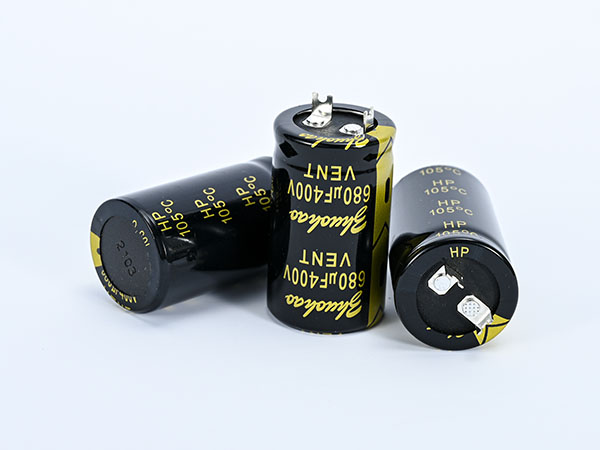
In the global electronic component market, aluminum electrolytic capacitors, as core components of power circuits, have long been divided into two main technical routes: solid-state and liquid-state. With the increasing demands for equipment reliability and lifespan in consumer electronics, industrial control, and new energy fields, the performance differences and application adaptability of the two types of capacitors have become a focus of attention for electronic engineers and buyers in Europe and America. A thorough analysis of their technical characteristics is crucial for optimizing circuit design and controlling costs.
I. Core Performance Parameters: A Comprehensive Comparison from Temperature to Lifespan
From a basic performance perspective, liquid aluminum electrolytic capacitors, using electrolyte as the dielectric, offer a significant cost advantage, but suffer from shortcomings in high-temperature stability and lifespan. Typically, their upper operating temperature limit is 105℃, and their rated lifespan at 85℃ is approximately 2000-5000 hours. Furthermore, due to electrolyte evaporation, the capacitance value can decrease by 10%-15% after long-term use. In addition, liquid capacitors have a higher equivalent series resistance (ESR), which can easily lead to significant power losses in high-frequency circuits, limiting their application in high-frequency switching power supplies. Solid-state aluminum electrolytic capacitors use polymer electrolytes, resulting in superior performance. Their operating temperature can be increased to 125℃, with some industrial-grade products even withstanding 150℃. Their lifespan can be extended to 10,000-20,000 hours at 85℃, with a capacitance decay rate of less than 5%. More importantly, the ESR of solid-state capacitors is typically only 1/3 to 1/5 that of liquid capacitors, maintaining stable impedance even at 100kHz high frequencies. They also exhibit stronger ripple suppression capabilities, effectively reducing circuit heat generation and improving equipment stability. However, solid-state capacitors are relatively expensive, costing approximately 1.5-2 times that of liquid capacitors of the same specifications, which is a significant constraint on their widespread adoption.
II. Application Scenarios Differentiation: Matching the Technical Needs of Different Fields
In the consumer electronics field, the two types of capacitors exhibit clear application scenario divisions. Liquid aluminum electrolytic capacitors, due to their cost advantage, are widely used in power boards of televisions and ordinary household appliances. These devices operate in relatively low-temperature environments (typically 25-40℃), requiring a capacitor lifespan of no more than 5 years, which liquid capacitors can fully meet. However, in motherboards and power supplies of gaming laptops and high-performance desktops, where CPUs and graphics cards generate significant heat at high frequencies, with ambient temperatures often reaching 60-80℃, solid-state capacitors become the preferred choice. Their high-temperature resistance and long lifespan ensure stable operation under high loads for 5-8 years, reducing maintenance costs.
The differences are even more pronounced in industrial control and new energy sectors. In industrial frequency converters and servo motor controllers, equipment needs to operate continuously in a wide temperature range from -40℃ to 85℃, with extremely high reliability requirements. Some equipment needs to operate fault-free for more than 10 years, making solid-state aluminum electrolytic capacitors the core choice. Taking the inverter products of a European industrial automation company as an example, after adopting solid-state capacitors, the equipment failure rate decreased by 35%, and the mean time between failures (MTBF) increased from 50,000 hours to 80,000 hours.
Liquid capacitors are still used in low-voltage auxiliary power supplies (such as 12V vehicle power supplies) of new energy vehicles. In these scenarios, the operating temperature is relatively controllable (approximately -30℃ to 60℃), and cost is a critical factor. Liquid capacitors can reduce the overall vehicle manufacturing cost while meeting basic performance requirements. However, in high-voltage inverters and charging pile power modules of new energy vehicles, due to their high operating temperature (up to 100℃ and above) and high power density, solid-state capacitors, with their advantages of low ESR and high temperature resistance, are gradually replacing liquid capacitors as the mainstream solution. III. Market Trends: Solid-State Capacitor Penetration Steadily Increases, Liquid Capacitors Still Have Irreplaceable Potential
According to a 2025 report released by the Electronic Components Industry Association (ECIA), the penetration rate of solid-state capacitors in the global aluminum electrolytic capacitor market has increased from 18% in 2020 to 27% in 2025, and is projected to exceed 40% by 2030. In the European and American markets, industrial control, new energy vehicles, and high-end consumer electronics are the core drivers of solid-state capacitor growth. A well-known European automotive parts supplier has even explicitly required that all newly developed automotive power supply products after 2026 must use solid-state aluminum electrolytic capacitors.
However, liquid aluminum electrolytic capacitors have not been eliminated. In low-to-mid-end consumer electronics and general industrial equipment—areas sensitive to cost and operating under mild conditions—liquid capacitors still dominate, and their market size is expected to remain stable over the next 5 years. Meanwhile, liquid capacitor technology is also continuously being upgraded. Some manufacturers have improved electrolyte formulas, extending their lifespan to 8000 hours and raising the upper limit of operating temperature to 125℃, further expanding their application range.
Both solid-state and liquid aluminum electrolytic capacitors have their unique technological advantages and applicable scenarios. For electronics manufacturers, it is necessary to scientifically select capacitor types based on the operating environment, lifespan requirements, and cost budget of their own products. In the future, as the cost of solid-state capacitors gradually decreases and the performance of liquid capacitors upgrades, the two technological approaches will coexist for a long time, jointly driving the sustainable development of the global electronics industry.

Leave a Reply